
Aviation security foundations, roles, and professional mindset
Modules 1-3 build the foundation: why aviation security exists, how responsibilities are shared, and how vigilance, discipline, and security culture shape daily behaviour.

Initial operational aviation security training for airport, airline, and ground operations personnel.
Sample mockup only. Your issued certificate will show Aviation Security Initial Course after successful completion.
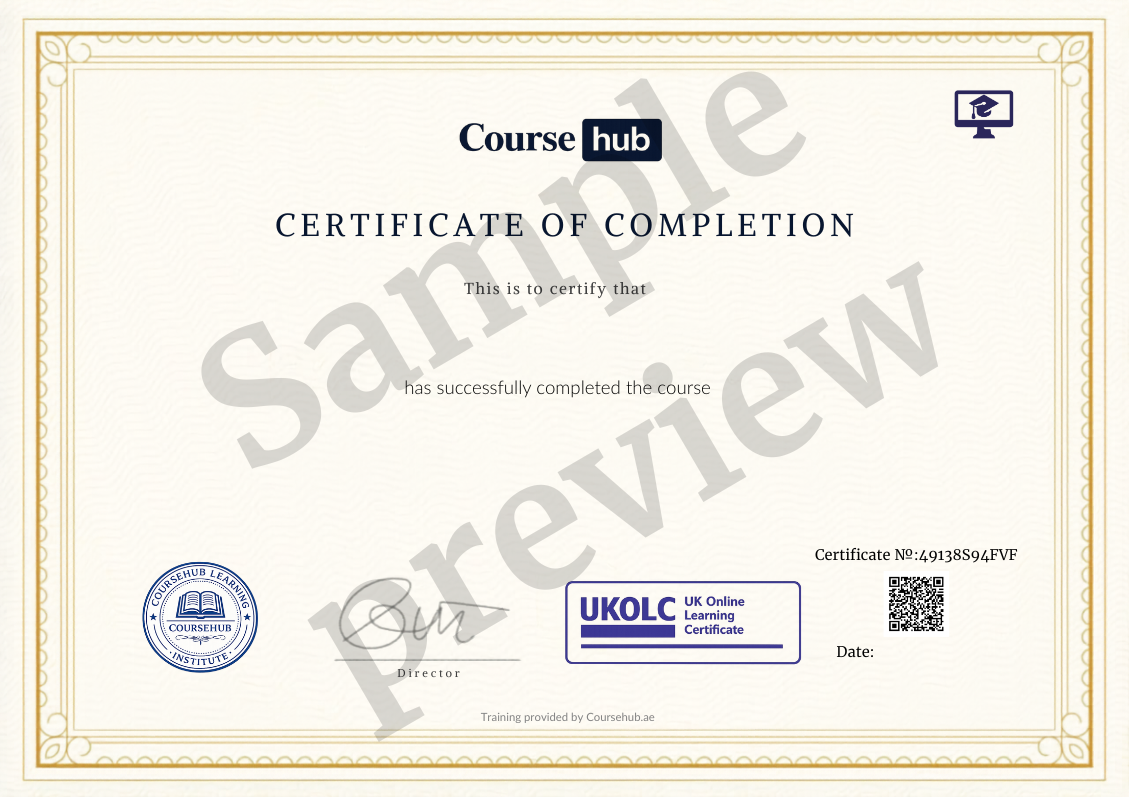
Successful learners in the certificate track receive a CourseHub certificate for Aviation Security Initial Course linked to the final assessment. The course is designed to support CVs, LinkedIn profiles, and employer-facing proof of completion.
Successful learners in the certificate track receive a CourseHub certificate for Aviation Security Initial Course linked to the final assessment. The course is designed to support CVs, LinkedIn profiles, and employer-facing proof of completion.
These are the core practical themes the course keeps reinforcing throughout the learning path.
Aviation Security Initial is designed for real operational environments, not abstract theory. Learners build awareness of access control, restricted-area discipline, aircraft protection, suspicious behaviour recognition, professional communication, and incident-reporting responsibilities across airport and airline operations. The course stays at professional awareness and initial operational level. It is structured to build correct judgement, vigilance, and secure daily behaviour without exposing sensitive tactical implementation details. The programme follows CourseHub's free-content and paid-certificate model: study the modules freely, then move into the certificate track when formal proof of completion is needed.
The programme is designed to move from orientation and method into application, completion, and next-step readiness.
Modules 1-3 build the foundation: why aviation security exists, how responsibilities are shared, and how vigilance, discipline, and security culture shape daily behaviour.
Modules 4-6 focus on airport identification, restricted areas, checkpoint awareness, screening logic, consistency, and referral discipline.
Modules 7-9 extend security awareness beyond checkpoints into baggage, cargo, supplies, aircraft turnaround activity, and suspicious findings.
Modules 10-12 connect communication, de-escalation, incident reporting, and integrated operational judgement through realistic scenarios.
Graduates of this programme are aligned with roles that value structured skill growth and visible evidence of learning.
Roles depend on experience level, market, and how the learning is applied after completion.
The key answers most learners need before they start or choose the next course.
If this course matches your interests, these programmes are natural next pages to compare.
A practical online course for branch bankers, retail sales staff, and banking contact center teams. Covers needs-based selling, product discovery, customer communication, ethical sales conduct, account opening, fair lending awareness, complaint handling, and relationship growth.
A practical online training course for call center agents and customer support teams. Covers communication, active listening, empathy, call handling, complaint resolution, documentation, QA awareness, and performance improvement.
A practical online course for auto insurance agents, advisors, and sales teams. Covers auto coverage basics, needs-based selling, quote explanation, deductibles, underwriting awareness, ethical sales conduct, objections, renewals, and customer service.
Access the full course library and begin building skills your career demands. Earn certification when you need proof of completion.